

Do you want to hear an uncomfortable truth? Many highly capable companies lose government bids to competitors that seem less qualified on paper.
It is a frustrating reality that even the most confident and qualified contractors, offering superior solutions, find that public sector procurement does not always award the contract to the best fit.
In many cases, a weaker-looking competitor secures the contract because its bid better fits the way the decision is being evaluated.
To understand why this happens, let us look at the real, often overlooked reasons capable companies fall short in government bidding.
Government Agencies Do Not Buy “Best”, They Buy Defensible
Government evaluators are not asking which bidder appears strongest in general. They are asking a much narrower and more practical set of questions.
They are asking:
- Who meets the stated requirements?
- Who reduces delivery risk?
- Who fits the scoring criteria?
- Who can be justified under audit or protest scrutiny?
That is what makes public procurement different from an ordinary buying decision. It is a structured, documented, and highly constrained process where every judgment must be tied back to the solicitation and evaluation framework.
As a result, evaluators reward proposals that show clear evidence, direct relevance, and precise compliance.
Now that we are on the same page about how procurement decisions are actually made, let us break down, one by one, the key reasons why even strong companies lose bids.
Reason # 1 Compliance Language Does Not Reflect True Capability
Many good companies assume evaluators will “see” their competence. But evaluators often score on what is explicitly mapped to requirements, not on what is implied in the proposal.
This is where even the strongest companies fall short. Instead of aligning tightly with the solicitation, they make avoidable mistakes, such as:
- Not mirroring the language of the solicitation
- Missing mandatory formatting or section requirements
- Burying key qualifications in the wrong section
- Using commercial marketing language instead of procurement language
This means that if a weak competitor is doing the above-mentioned things well, it can simply win by being compliant. In short, in the public sector, clarity and compliance in bids can beat a strong company profile.
Reason # 2: The Proposal Fails to Match Evaluator Logic
Evaluators do not score companies on intuition or overall impressiveness. There is a defined framework that the evaluators use to judge the proposals. Every section, claim, and response is evaluated according to specific criteria.
Yet many companies make the mistake of writing proposals to sound strong, rather than to score well. This leads to predictable gaps. Some proposals fail to map their claims directly to the stated evaluation criteria, leaving evaluators to determine how strengths align with the scoring factors.
In short, if the evaluator has to interpret your value, you are already weakening your proposal.
Reason # 3: Risk is Framed Poorly, Or Not Addressed At All
Government buyers are highly sensitive to execution risk. Even a strong contractor can lose if the proposal leaves open questions.
- Delivery: How will the work actually be executed?
- Staffing: Does the team have the right skills, experience, and availability?
- Transition planning: How smoothly will the contractor take over or hand off the work?
- Cybersecurity: How will risks to data and systems be identified and mitigated?
- Subcontractor management: How will third parties be coordinated and held accountable?
- Project continuity: How disruptions will be handled to ensure consistent progress?
This is where major companies often make mistakes. They assume that their experience will speak for itself. However, evaluators are looking for reassurances and a strategy for all of the above-mentioned segments.
If you want your proposal to win, remember that strong credentials do not necessarily cancel out perceived risk.
Reason # 4: The Proposal Talks Too Much About the Contractor
When writing a proposal, companies tend to write it from their perspective rather than the evaluator’s. Factors like who the company is, what it does, and why it is qualified for the contracts, do play a part in your selection process, but are rarely enough to persuade a government evaluator. Because they are looking for a solution to a specific problem, and submitting a bid that heavily relies on self-biography will not do much for you.
Evaluators respond more strongly to proposals that not only describe the contractor’s capabilities but also demonstrate a clear understanding of what the agency is trying to achieve, what could go wrong, and how success will be measured.
Reason # 5: Many Bids Are Lost Long Before the Proposal Is Written
A strong proposal cannot always rescue a weak capture strategy. By the time a Request For Proposal (RFP) is released, many of the factors that shape the outcome are already in motion.
Customer understanding, teaming decisions, solution design, contract vehicle access, and prior positioning efforts often influence how competitive a bidder will be before the writing process even begins.
This is why a less capable firm can sometimes appear stronger in the final evaluation. If it
- Engaged earlier
- Understood the agency’s needs more clearly
- Built the right team
- Aligned its solution before the opportunity formally opened
It may enter the bidding stage with a sharper and more relevant offer. Meanwhile, a more capable company that arrives late may be forced to react rather than shape.
Platforms like Lead Pursuits can help you quickly and efficiently by identifying the right opportunities which can help you stay ahead of your competition.
Reason # 6: Unrealistic Pricing, A Potential Red Flag
Many contractors misunderstand price evaluation. Unrealistic pricing in both cases, whether it is too low or too high, can create concern.
That is because pricing is not judged in isolation. Evaluators often read price as a signal:
- Does it look credible for the work being proposed?
- Does it align with the technical approach, staffing plan, and delivery model?
- Does it show a realistic understanding of the effort required?
These questions matter because price helps shape the evaluator’s confidence in the overall proposal.
This is why a weaker competitor can sometimes appear more fundable than a stronger one. If their pricing is more coherent, better aligned with the proposed solution, and easier to defend, evaluators may see them as a safer choice.
How Can Contractors Position More Strategically?
Experts at Lead Pursuits have engineered a few steps that can help you position yourself as a trusted and strategic contractor.
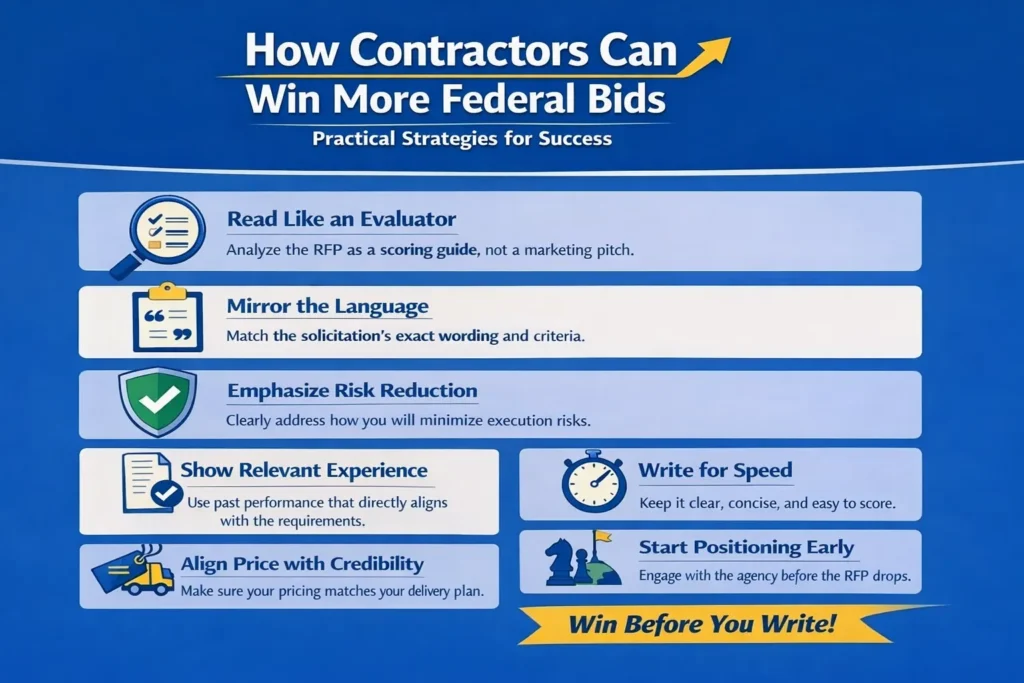
Winning is About Fit, Not Just Merit
Strong companies do not lose government contracts only because of bad luck, or weaker competitors undercutting them. More often, they lose because public procurement rewards something far more specific: alignment, clarity, relevance, and defensibility.
Join our platform to discover relevant government contracts and position your business with the clarity, alignment, and credibility needed to win.