

The Hidden Side of the Government Bid Evaluation
Is your strategy to win a contract by simply being the cheapest?
You might want to pause for a second. In government contracting, price alone rarely wins deals — even though many businesses believe it does.What really matters is understanding what procurement teams expect. And it’s not always obvious. They’re looking beyond numbers — at reliability, clarity, and how well you actually solve their problem
Surprising? It shouldn’t be. Many strong companies lose contracts not because they’re overpriced, but because they miss what procurement teams needs from the very beginning.
Many government bids are eliminated before evaluators even compare prices, simply because they fail basic compliance or miss key requirements.
In reality, many requirements are not explicitly stated in the tender documents, and bidders often misinterpret what evaluators are truly looking for, including procurement team roles and responsibilities.
This is why the team at Lead Pursuits has accumulated everything you need to learn and unlearn about government contract bidding to bring your A game to the table.
Let us discuss each one of them in detail.
Clarity Over Complexity: Why Simple Proposals Win
The very first thing that an evaluator is going to see is your proposal. And it is the most important thing if you are to win a contract.
Let us make it easy for you. The procurement team is looking for the following things in your draft:
- Does the proposal include clear responses to each requirement listed in the Request for Proposal (RFP)?
- Is the proposal draft well structured and easy to navigate, because if it is not, then the evaluator does not bother to read it at all?
- Does your proposal have direct answers rather than long narratives and marketing language?
So here is how you will make your proposal approval ready:
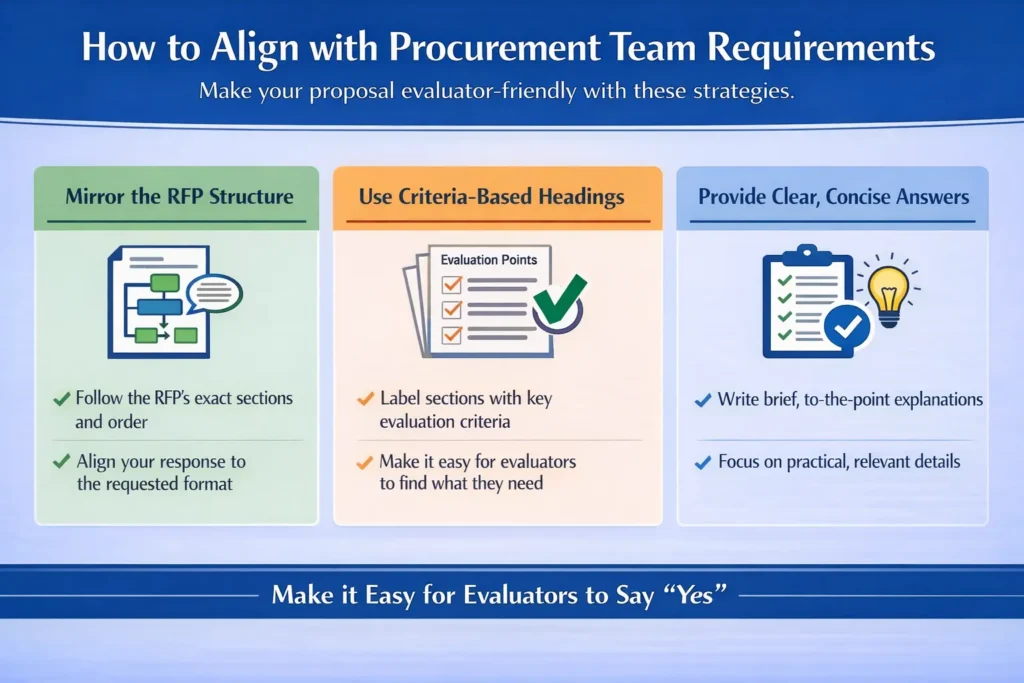
If your draft is simple, well structured, and answers all the questions/requirements of the RFP, your chances of winning the contract just increase by quite some percentage.
Risk Mitigation, What Procurement Teams Expect
Do you know what the procurement team focuses on so heavily?The risk factor.
Imagine a supplier fails to deliver the project on time. The consequences of this extend far beyond the project itself. That is why procurement teams naturally evaluate bids through a risk lens.
When reviewing a proposal, procurement teams are often trying to identify whether the bidder introduces unnecessary risk in key areas:
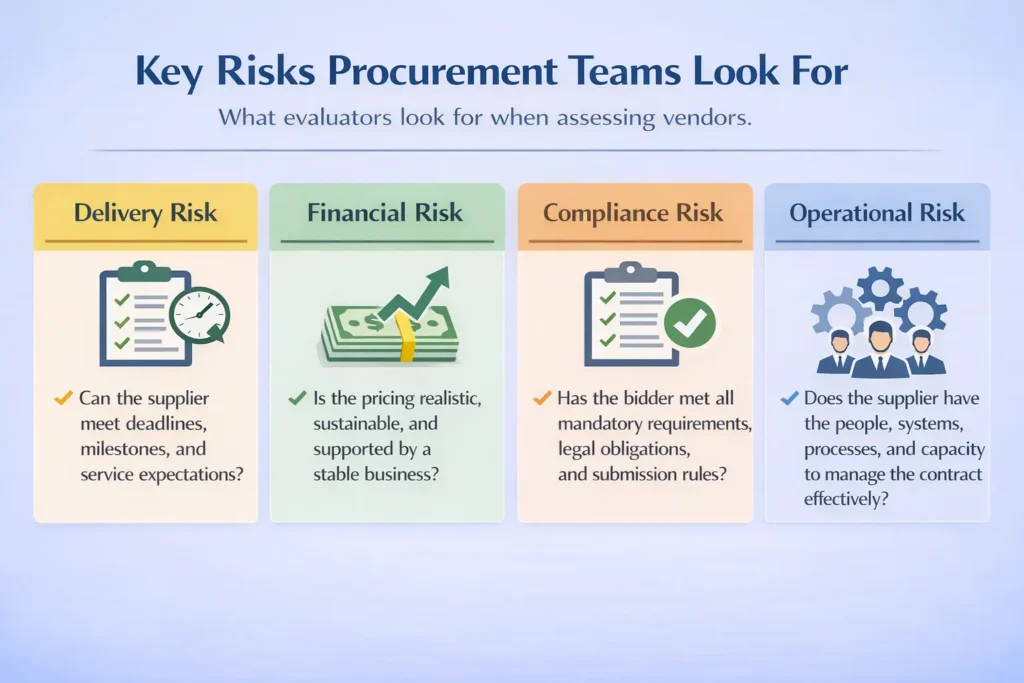
So what should a smart bidder do to reduce the perceived risk?
- Provide clear project timelines, which are realistic and include key milestones.
- Always have contingency planning, demonstrating how potential risks or delays will be managed through backup plans.
- A proven track record supported by past performance, completed projects, client references, and measurable results that demonstrate your capabilities.
This way, you will be able to build trust in your bidding proposal and process.
Responsiveness: The Fastest Way to Lose or Win a Contract
With our proposal sorted and the risk factor mitigated, another very important priority for a procurement team’s evaluation is responsiveness. What responsiveness really means is that you follow the tender compliance religiously.
A proposal may offer strong technical capabilities and competitive pricing, but if it fails to meet submission requirements, it can be rejected before evaluators even consider its merits.
To make it clearer, here are a few of the most common errors that contractors make while applying for a contract.
- Missing mandatory forms when submitting the bid.
- Ignoring formatting requirements while writing the proposal.
- Partial answers to procurement tender questions mentioned in RFP.
A practical tip to avoid these common mistakes includes creating a compliance checklist so you can cross-reference the requirements without missing anything.
Evidence Beats Claims: Show, Do not Tell
Procurement teams are far more persuaded by proof than by promises. Many proposals make broad claims about experience, quality, or capability, but evaluators place greater trust in evidence they can verify. The stronger your evidence, the easier it becomes for procurement teams to justify confidence in your bid.
Imagine yourself as a procurement review specialist, and you have two proposals in front of you.
The Weak Proposal:
- “We have extensive experience.”
The Strong Proposal:
- “Delivered 12 municipal infrastructure projects worth $45M within schedule.”
It is quite obvious which contractor you will pick here.
In procurement, credibility is not built by saying you can deliver. It is built by showing what results you have delivered in the past, and how.
Pricing Still Matters, But Not the Way You Think
Price always matters in public procurement, but not simply in the sense of choosing the cheapest bid. Procurement teams are usually looking for a price that is credible, transparent, and aligned with the scope of work.
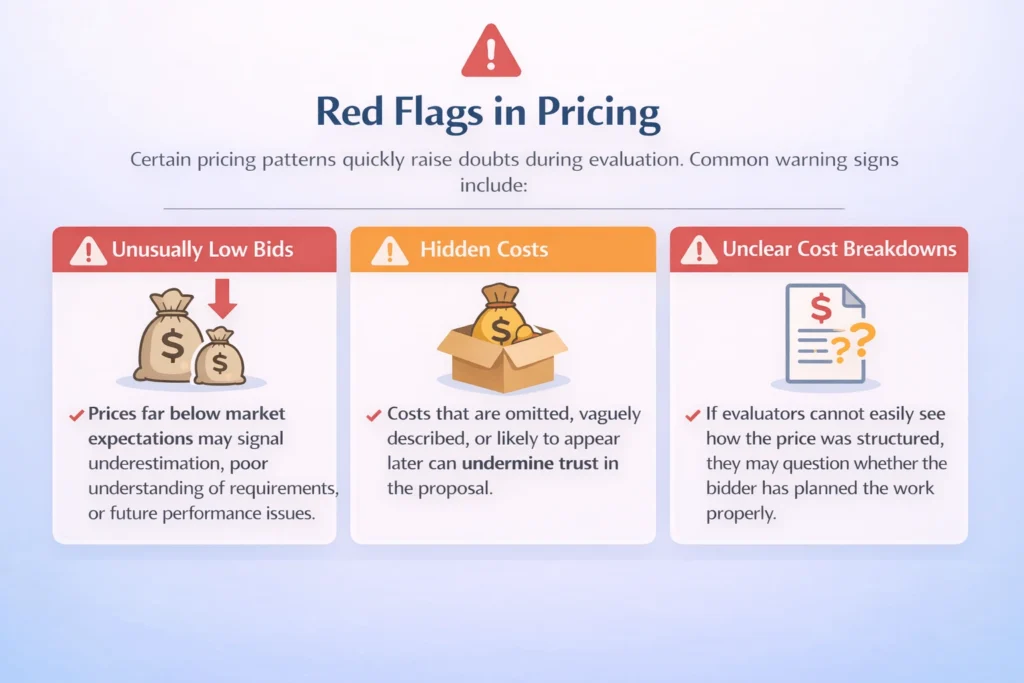
An unrealistically low price, lacking justification, is more likely to raise suspicion than build credibility with a procurement team. This makes the structure of your pricing approach another very important priority when applying for a government contract.
There are three things the review panel wants to see in your pricing approach:
- Cost Transparency: A clear breakdown of what is included, how the total was built, and whether the bid is financially credible.
- Value for Money: A proper demonstration that the price is justified by the quality, capability, and outcomes being offered.
- Realistic Cost Structures: Pricing should appear achievable and sustainable, with costs that match the actual scope, resources, and delivery requirements.
If you structure your pricing right and avoid a few of the red flags given below, then you now stand at a very high probability of winning the contract.
Winning Bids Are Designed for Evaluators, Not Contractors
Successful bids are not necessarily the most complex or impressive documents. In fact, they are:
- Simple proposals
- Well-structured pricing
- Contractor’s responsiveness
- Experience supported by evidence
- Contingency plans
The key takeaway is that successful contractors stop writing proposals for themselves and start writing them for the evaluators.
Want to learn more about what the procurement team expects from a contractor? Book a demo with us now.
The four main roles are procurement planning, solicitation (tendering), evaluation & contract award, and contract management. Together, they ensure a fair, transparent, and efficient process from identifying needs to delivering the final project.