

First Government Contract For Beginners Starts Here
“I am going to fail the government contracting process”. This is what most first-timers have in their minds when applying for their first-ever gov contract opportunity. Do not worry, we have got your back.Government contracts for beginners does sound a little intimidating until you realize it is mostly paperwork, process, and showing up prepared.
At Lead Pursuits,we have carefully curated a government contracting guide that provides a clear, first-timer-friendly step-by-step roadmap . It will include,
- How to register on Sam.gov.
- How to write your first government contract proposal.
- Information around key terms, NAICS codes, and certifications.
- 12 Common mistakes that can derail beginners.
Let us start at the very basics to understand how the process works.
What is Government Contracting
It is quite similar to what you normally do as a company: you sell your service or product. But this time, your customer is a government agency.
The public agencies buy everything, from office supplies and software to construction, consulting, marketing, and maintenance, and often through a structured bidding process.
At a high level, you can bid for two types of contracts.
- Fixed-Price Contracts: Where you deliver for an agreed amount.
- Cost-Reimbursement Contracts: Where the government reimburses allowable costs under stricter oversight.
These projects are posted as solicitations in the form of Request For Proposals (RFPs) or Request for Quotation (RFQs) on various platforms. Vendors can submit their bids on the project of their choice. The agencies then evaluate the bids based on stated criteria before awarding.
The 5-Step Primer: How to Bid on Government Contracts For Beginners
Now that we know what government Federal contracting is, let us explore the next steps. To actually be in the game, you can do one of two things:
- Sell or bid as a prime contractor, meaning you lead and deliver the entire contract work.
- You can be a subcontractor, where you support a prime contractor and build past performance faster(which is a parameter your bid is judged on).
But how will a federal agency identify you as a legitimate vendor?
SAM.gov: Your Front Door to Federal Work
Sam.gov is here for your rescue. It is the U.S. federal government’s official system for vendor registration and award data. In simple words, this is where federal agencies (and prime contractors) can verify that you are a legitimate vendor. This platform is also where many federal opportunities and award records live.
If you want to apply or compete for a government opportunity, especially as a prime contractor, then a correct and current SAM registration is often a baseline requirement.
Even when it is not a mandatory requirement for a specific project, as a first-timer, registering yourself improves your credibility, makes you easier to validate, and reduces last-minute delays when a solicitation moves quickly.So This Is Helpful for beginners who are trying to get Goverment contracts
Here is what you need before you start the registration process,
- Legal Business Information: This information is very crucial, and it must match exactly. It includes the legal business name, physical address, mailing address, and entity type/structure.
- EIN/Tax ID + Banking Information: This includes EIN (or Tax ID), bank account, and routing details for electronic payments.
- Points of contact + Capabilities Summary: Owner/admin contact, contracts contact, email/phone, and a short “what we do” summary (services/products, core differentiators, past work highlights)
And after you have made sure all of your above data is gathered, these are the next steps that you will follow.
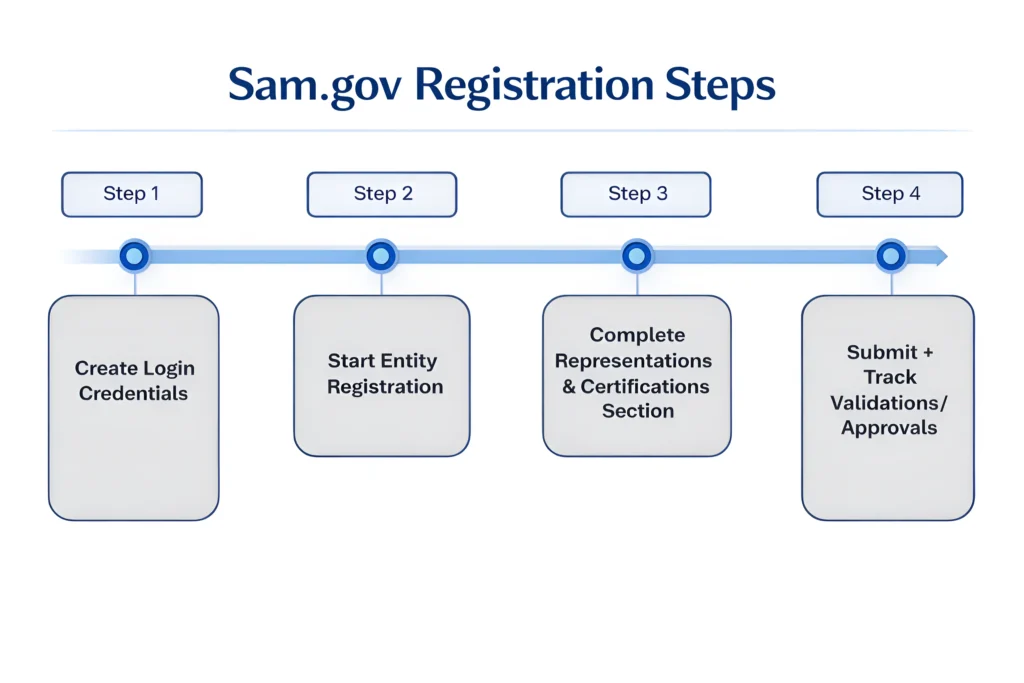
NAICS Codes: The Labels That Decide What You Can Bid On
NAICS codes are standardized industry labels that government buyers use to categorize their purchases. But do they matter?
These codes are very important because agencies use NAICS to filter searches, determine which vendors are a good fit, and apply small-business size standards for set-asides.
In simple words, the right NAICS codes help you show up in the right opportunities, and the wrong ones can hide you from the work you actually do.
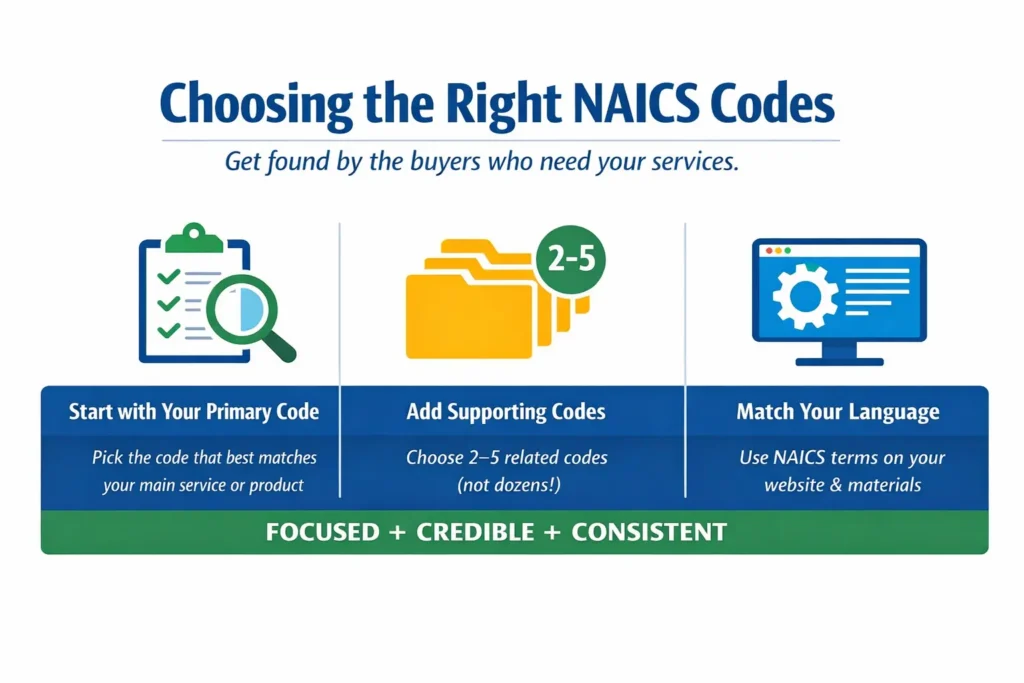
Now, how will you choose the right NAICS code?
Here is what beginners need to do For Government Contracts.
Certifications & Set-Asides: Your Shortcut to Smaller Competition
Certifications in government contracting do two things,
- They can make you eligible for certain competitions (set-asides).
- They can make you more attractive to buyers and prime contractors looking to meet small business goals.
In many cases, certifications do not replace strong performance, but they help you get into the right lane where you are competing against a smaller, more relevant pool.
How to decide what is worth pursuing?
- Eligibility first, then effort vs payoff: only pursue what you truly qualify for, and weigh time/cost against your target contract pipeline.
- Match your strategy: prioritize certifications that align with your target agencies, contract types, and what you actually sell.
Your First Opportunity: How to Pick the Right Contract to Bid
Choosing the right platforms can help you stay visible, set alerts, and track opportunities. So you are only bidding on work that fits your NAICS and capabilities.
Lead Pursuits makes this easier by centralizing your searches, templates, and bid/no-bid decisions in one place
However, before opting for any project on any platform, the most important thing to notice is that agencies judge your bid on the basis of,
- Compliance (following instructions)
- Relevant past performance
- Price realism/value
- Low-risk delivery
But you need to remember that the best opportunities are the ones you can actually deliver and comply with, fast.
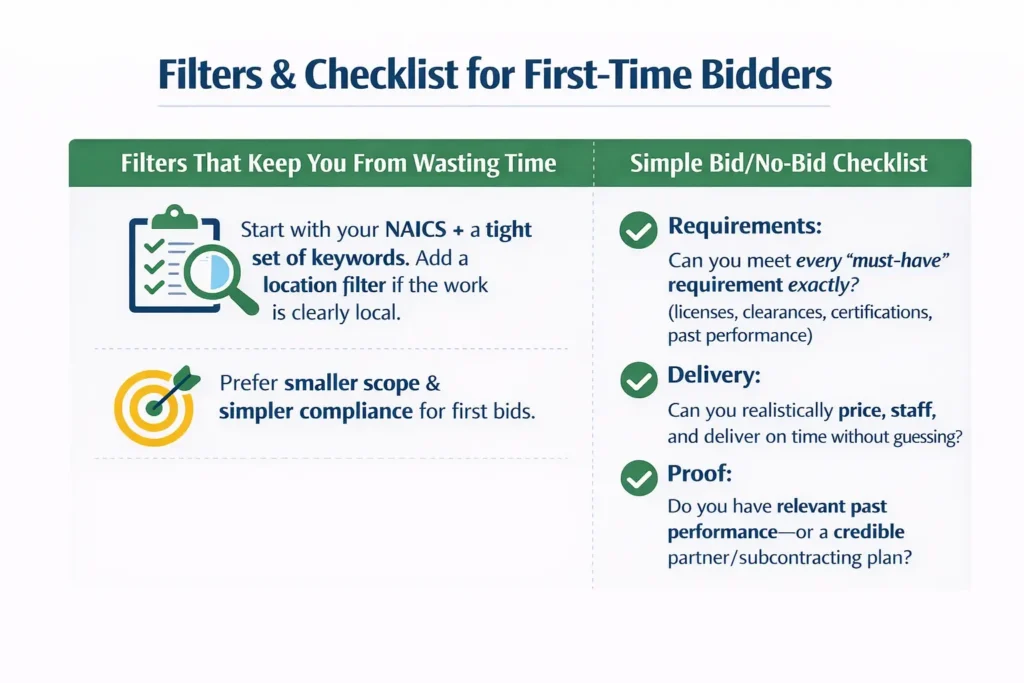
As for the platform, start by setting up saved searches on SAM.gov Contract Opportunities using your core keywords and NAICS codes. Then you can start widening your pipeline through teaming with primes who already win work and need qualified partners, and vendor outreach events like agency small business briefings and industry days.
Your First Proposal: A Beginner-Friendly Blueprint
The golden rule for writing your first proposal is that you follow the instructions exactly mentioned in the solicitation, including format, page limits, file naming, and deadlines. We suggest that you build a compliance matrix by turning the solicitation into a checklist to make sure you do not miss anything.
Then comes the proposal structure. Here is an illustration explaining what you need to do,
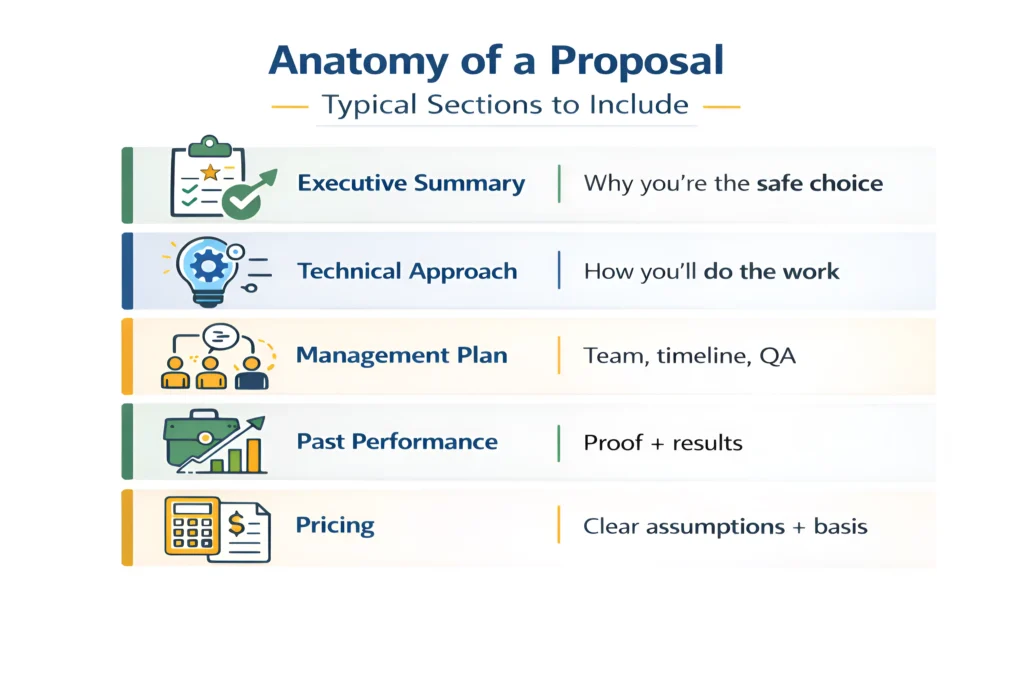
Even after following all the basic steps, there are some common mistakes that beginners make that can derail their entire public contracting process. We have highlighted 12 common mistakes that can affect your bidding process.
The “Don’t Do This” List: 12 Rookie Mistakes That Kill Bids
Here is the list of mistakes For Beginners that they need to avoid while applying for government contracts.
- Treating SAM.gov registration as “done” but leaving key sections incomplete.
- Using NAICS codes that do not match your actual offerings.
- Chasing every opportunity instead of focusing on a niche.
- Skimming the solicitation and missing mandatory requirements.
- Ignoring evaluation criteria and writing what you want instead.
- Not creating a compliance matrix/checklist.
- Weak past performance write-ups with no outcomes, metrics, or relevance.
- Overpromising staffing, timelines, or capabilities.
- Pricing without clear assumptions or a basis of estimate.
- Submitting at the last minute and having portal/file issues.
- Formatting that is hard to scan, meaning walls of text, no headings.
- Failing to request feedback/debrief and improve the next bid.
Take the First Step
A repeatable process makes government contracting easier for beginners, especially when targeting the easiest government contracts to win . Get your SAM.gov profile right, choose the correct NAICS codes, target a few agencies, and submit one well-aligned bid, then improve with every attempt.
Want help putting the basics into action? Book a demo with us to get step-by-step guidance and resources to start bidding faster.